
A Tale of Two Volcanoes
I recently visited Italy on a tour that took us to Venice, Florence, and Rome. One day, while we were based in Rome, our group headed south to see Pompei, the ancient city destroyed by Mount Vesuvius in 79 AD.
If my five years of studying Latin in middle and high school offered me anything, it was an appreciation for just how world-changing that eruption was. As our bus neared the modern-day city of Pompei, I felt that mix of anticipation and awe you get when you’re about to stand in the shadow of history.
Touring the archaeological ruins, we learned some facts that were both fascinating and unsettling.
For one, the people of Pompeii didn’t know Mount Vesuvius was a volcano. To them, it was simply a mountain looming nearby: quiet, familiar, and (seemingly) harmless.
That wasn’t just because they lacked modern sensors and instrumentation. It was also because Vesuvius hadn’t erupted in living memory. The previous eruption may have been centuries earlier. Aside from a handful of earthquakes, there were no obvious warning signs available to everyday Pompeiians that they were living next door to something capable of catastrophic destruction.
We also learned that today’s Vesuvius is missing about one-third of its original size. Before 79 AD it was larger and more symmetrical, but that eruption blasted away the summit.
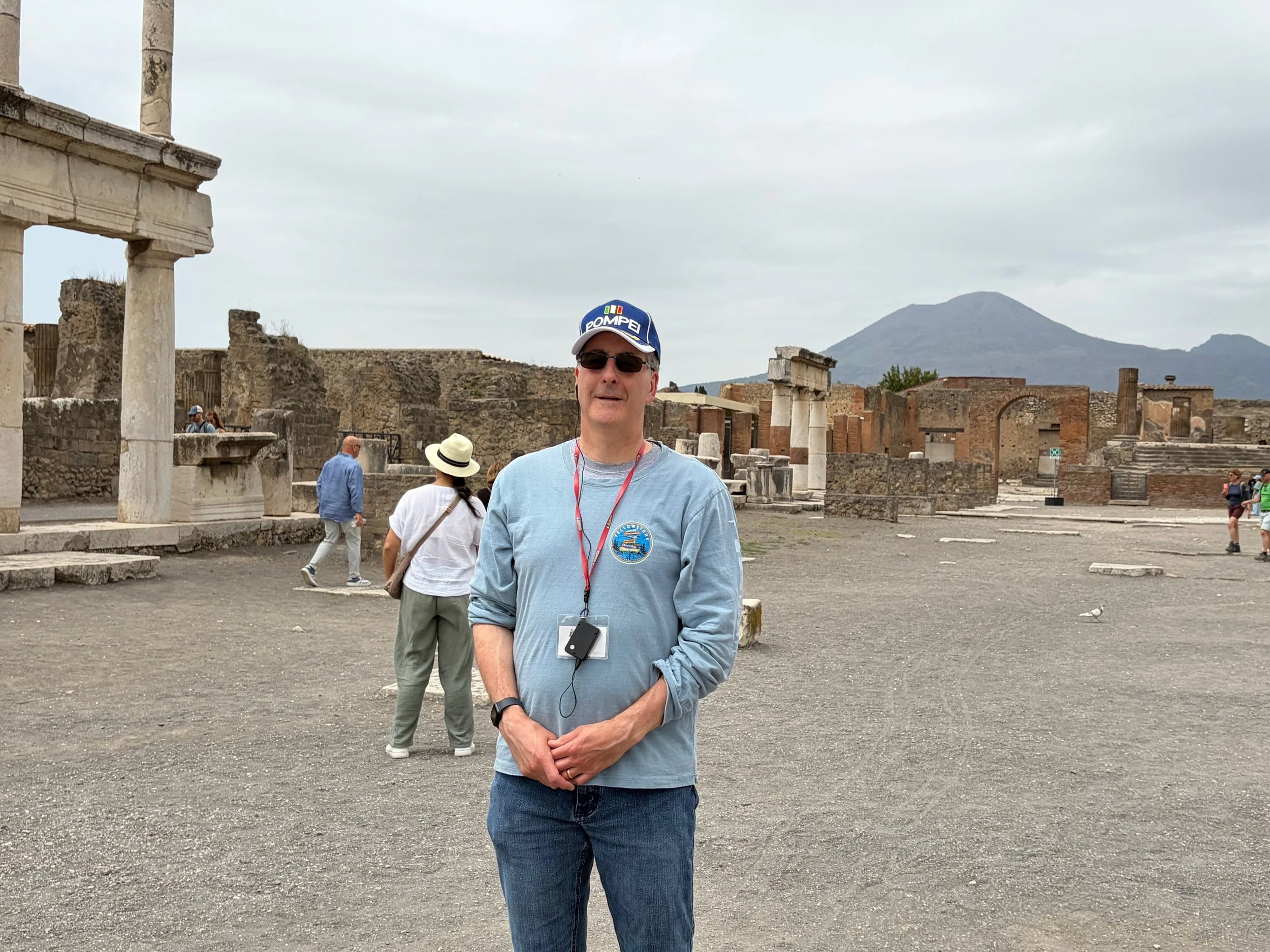
A picture of me at the Pompeii archeological site with Mt. Vesuvius looming in the background
The most stunning fact came later, as we boarded the bus for the ride back to Rome.
Our tour director told us that Mount Vesuvius isn’t the biggest volcano in Italy. That title goes to Mount Etna on the island of Sicily. Etna is roughly 2.7 times as tall as present-day Vesuvius. Unlike Vesuvius, Etna is active and erupts relatively often.
This raises a fair question:
Why does Mount Etna pose comparatively little threat to many residents of Sicily, while Vesuvius annihilated Pompeii and its inhabitants?
The answer is a bit counterintuitive. Since Etna erupts regularly, it releases pressure. It doesn’t allow internal pressure to build for centuries into something truly explosive. Etna also has multiple craters and flanks that provide frequent outlets for gas and lava. In a sense, Etna is always venting.
Vesuvius, by contrast, behaves like a pressure cooker, quiet on the surface while pressure accumulates over long stretches of time, until it’s finally relieved in one enormous, devastating event.
There’s one more twist: Etna’s frequent eruptions contribute to rich, fertile soil across parts of Sicily. That’s a significant benefit, an almost poetic contrast to the destructive impact of Vesuvius’ infrequent (but catastrophic) expulsions.
The Organizational Metaphor
These two volcanoes are interesting from a geological perspective, but they also make a surprisingly useful metaphor for how organizations handle the pressure and tension that naturally build up as people work together.
The “Mount Etna” Organization
Some organizations create space for the timely airing of different perspectives. They’ve built enough psychological safety that people can say:
“I see it differently.”
“I’m concerned about this.”
“I don’t think this will work.”
“Can we talk about what’s not being said?”
In these environments, you may see more day-to-day disagreement, sometimes even heated conversations. But importantly, the pressure gets released in manageable doses.
Over time, these organizations tend to:
Make better decisions
Find better solutions
Improve how they work
Reduce long-term resentment and frustration
They may look messy up close, but they’re healthier over the long run.
The “Mount Vesuvius” Organization
Then there are organizations that discourage contrasting perspectives or simply never develop the psychological safety required for people to speak up.
In these environments:
Difficult conversations get postponed
Concerns get softened, filtered, or withheld
Problems don’t get addressed while they’re still small
People learn that silence is safer than honesty
From the outside, these organizations can look “aligned.” They may even appear calm and conflict-free.
Under the surface, however, the pressure builds. Without regular outlets for truth-telling and healthy disagreement, emotional lava accumulates: resentment, frustration, cynicism, and burnout. Eventually, the organization reaches a critical pressure point.
And when a Vesuvius organization “erupts,” it often looks like:
A blow-up meeting that changes relationships overnight
A sudden wave of attrition (“key people leaving all at once”)
A strategic failure that was predictable, but unspoken
Leaders losing effectiveness as they burn out from holding everything together
Here’s the ironic part. If you only watch day-to-day interactions, a Mount Etna organization can seem like it has more conflict than a Mount Vesuvius organization. But the long-term prognosis for the Etna organization is usually better. It learns, pivots, and self-corrects, often avoiding the dangers that come with operating in a competitive and constantly changing marketplace.
The Vesuvius organization, on the other hand, may look fine…right up until it isn’t.
A Leader’s Choice
As a leader, it can feel harder day-to-day to run a Mount Etna organization. You may have to facilitate uncomfortable conversations, tolerate tension, and resist the temptation to “keep the peace.”
But ask the people of Pompeii what happens when a high-pressure volcano finally erupts.
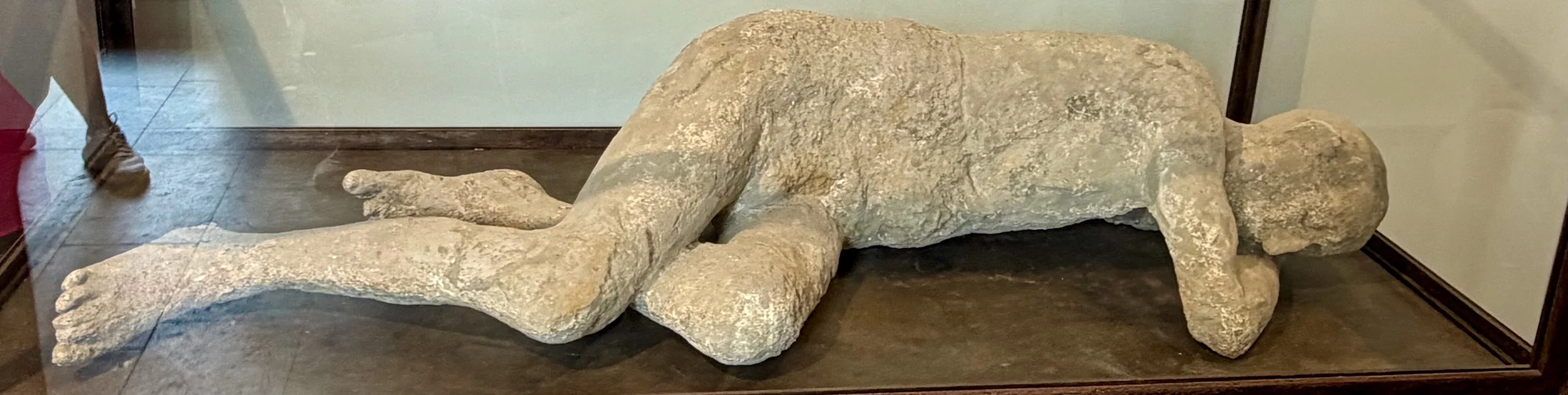
A plaster cast of a Pompeii resident killed by heavy ash expelled by Mount Vesuvius
Suggested Actions for Senior Leaders
If you want the benefits of a “Mount Etna” organization without waiting for a “Vesuvius” moment, here are three moves that senior leaders can consider putting in place.
1) Make dissent a required input to major decisions
Before committing to high-impact decisions, explicitly ask for and document the strongest counterargument:
What are we missing?
What would make this fail?
If we’re wrong, why will it be?
The goal isn’t to slow decisions down. It’s to create the appropriate level of contrarian pressure early, while changing course is still cheap.
2) Run a standing, time-boxed “pressure review” in your leadership meeting
Dedicate 10 minutes on the agenda every week to ask:
Where is pressure building in the organization right now?
What conversations are being avoided?
What decision or tradeoff needs to be made explicit?
Treat what you hear as a signal as to where discussions need to take place.
3) Model psychological safety in the moments that matter
The fastest culture message you send is how you respond when someone brings bad news or disagreement.
Thank them for raising it.
Ask at least one curious follow-up question.
Decide what happens next
That consistent response is what turns “speaking up” from a risk into a norm.