
April Habits Lead to Victors Valiant
Earlier this month, the University of Michigan Men's basketball team won the Division 1 National Championship by defeating the University of Connecticut (UConn) Huskies, 69-63, in the championship game.
In some ways, this is not that remarkable because one team wins the national championship every year. In fact, UConn won two of the previous three championships. However, this is only Michigan's second national championship in men's basketball, with the first coming 37 years prior when I was a senior at the University of Michigan, enjoying the wind down of my four years in Ann Arbor.
Yet this is not what makes this year's Michigan team noteworthy. The Wolverines won in a way that no team had ever won before. All five of their starting players began their collegiate playing career at schools not named the University of Michigan, with four of those five arriving only at the beginning of this academic year. The college athletics landscape has changed dramatically in the last several years with the loosening of restrictions on student-athletes transferring from one school to another (sometimes every year) and the ability of both schools and private collectives to pay athletes through a Name, Image, and Likeness (NIL) framework. When the environment changes, the best teams and organizations find new ways of working and new strategies to explore.
There are many ideas and lessons to be learned from this Wolverines team that we can apply to our various organizations, even though our organizations are much larger and complex that a college basketball team.
People Need to Be in the Right Environment
Two of the players who chose to transfer to Michigan during the offseason came from schools where there were not getting the outcomes they had hoped for.
Elliot Cadeau was a five-star (the highest level) recruit who played two years at the University of North Carolina. His performance as point guard at UNC was questioned because of a high level of turnovers and a poor outside shooting percentage. Cadeau said of his time at UNC, "Last year, I was really down on myself. A lot of people doubted me." He added, "They said I couldn't do it, they tried telling me I was ass." Cadeau was labeled a bust by many in the UNC fan base. His confidence was impacted by being pulled from the court by the UNC coaching staff when he would miss a shot. What Cadeau needed was a staff that would trust him and give him the autonomy to be himself and rely on his strengths out on the court.
Compare this to how Coach May talked about Cadeau during the season. May stated, "He's a savant with what he's doing, and he probably doesn't even realize all the things that he's doing because he's so intelligent. He's able to get us in and close out opportunities without really having to run any offense. His ability to read the floor, read the game, and manipulate the defense is incredibly impressive." When Cadeau had a bad game against Duke, May responded, "I'm riding with Elliot. I thought he did a nice job overall... He's what we want in a point guard, he's a guy that makes everyone on the team better."
Cadeau was a key part of the Wolverines winning the national championship. He was named to the Midwest All-Region Team, to the NCAA All-Tournament Team, and most notably, the NCAA Tournament Most Outstanding Player.
Likewise, Aday Mara, a 7 foot 3 center, was mired on the bench at UCLA with a coaching environment that Mara considered to be less than ideal. Mara stated after transferring to Michigan in July, "I just talked with Coach [May] and he told me about the style of game, the way he used the big man... I was looking for opportunity. You know, I didn’t get the opportunity these last two years [at UCLA]. So, I think that will be the key of being here." Mara felt that head coach Dusty May’s offensive philosophy was the perfect match for his skill set. Upon arriving in Ann Arbor, he praised the team's collaborative nature: "I practiced the first day, I was impressed that we weren't selfish. We like to pass the ball. We're smart. We know where we have to be." Rather than the high-stakes, pressure-cooker environment where players might feel they are one mistake away from being benched, Mara has described a system at Michigan where the coaching staff focuses on confidence. This allowed him to play with the creative flair he was accustomed to in Europe, without the "heaviness" that he felt stifled his development at UCLA.
How did this different in environment manifest itself with regard to Mara's performance? At UCLA, Mara often struggled to stay on the floor due to concerns about his foot speed in space. At Michigan, he was named the Big Ten Defensive Player of the Year. While he remained a "drop coverage" specialist, his positioning improved significantly, and he led the Big Ten in block percentage at 12.7%. He became the ultimate rim protector, discouraging and changing opponents' shots throughout the season.
Where UCLA saw a situational sub with mobility issues, Michigan saw a modern, passing big man who could anchor a Top-10 defense. Mara increased his scoring from 5.0 points per game at UCLA to 12.1 points per game at Michigan. He also went from 0.8 assists per game to 2.4 assists per game, a significant number for a 7 foot 3 inch center.
He effectively transitioned from a player relegated to the bench and denigrated by his former coach to a projected 2026 NBA Draft selection and possible lottery pick.
So what can we learn about how we select and develop our people? Look for people with natural talent, share with them your vision for their development and their contribution to your organization's efforts, then nurture their development with opportunities to further develop their skills. Put them in a system that accentuates their strengths and pair them with teammates whose skills are complementary. Treat them with respect, kindness, and honesty.
Also note that how someone performs in one organization is not necessarily how they will perform in your organization. Environment and culture matter, as does investing in the development of the people you bring into your organization. It is not enough to just hire high performers from other companies.
Flexibility is an Important Ability
One of distinguishing characteristics of the Michigan team this year was their ability on defense to switch off their assignments in the face of picks and other schemes designed to free the ball handler from his defense. The fact that Michigan chose to switch on picks is not totally unusual. Some teams have their players fight through picks and others lay back and let one of their teammates on the other side of the pick take over defending the ball handler. However, usually switching comes with consequences, namely that this might create mismatches that the offense can exploit. If a smaller defender winds up guarding a bigger offensive player, the offensive player might try to post up the smaller defender near the basket. If a bigger defender switches to cover one of the guards or small forwards, they might find themselves unable to keep the offensive player from quickly scooting around them and driving to the basket or running around to get an open three-point shot.
However, because most of Michigan's players are super-athletic and are able to guard multiple types of players, there were very few mismatches on the switches throughout a game. While people immediately notice how tall Michigan's players are, especially with their starting lineup featuring 3 players 6 foot 9 inches or taller, they often overlook the fact that at how agile even Michigan's big men are. Yaxel Lendeborg, the most heralded of Michigan's transfers this season, at 6 foot 9 inches tall, was able to guard point guards all the way to centers at the highest defensive effectiveness. In fact, Michigan ranked #1 in the nation in defensive efficiency according to the oft-cited KenPom ratings.
This extends to the offensive end as well. Michigan players were able to score close to the basket with their height and their outstanding passing led to lots of easy baskets and open three-point shots. They did not have a singular superstar on offense. In fact, Michigan had four players who averaged at least 10 points per game - five, if you round up Trey McKinney's 9.9 point per game average.
Put this all together, and it means that Michigan could overcome poor shooting by some of its players given that they had other players who were capable of picking up the scoring slack. On defense, their ability to switch and defend against many diverse schemes kept them effective on defense no matter what they faced. Having so many options and high level of resilience are especially important when you are in the single elimination NCAA tournament where one bad game ends your season immediately.
What's our lesson here? In basketball, the flow of play is fluid and dynamic, so you need to be as prepared as possible for different matchups and situations. Likewise in our organizations, the combination of talents and perspectives we need working together changes rapidly, certainly more rapidly than our formal organizational structures can change. As one example, advances in AI have changed the nature of what combination of skills are needed as we develop products. The uncertainty of how AI will evolve and its impact on how we work will continue for some time. In this type of environment, people who are generalist and can play several roles as needed are going to be more value that specialists whose value is very context-specific. While you will always need some specialists and you may find that it is harder to find people who can contribute to your organization in a multitude of ways, going through the effort of finding and developing these generalists will make your organization more likely to succeed no matter how much or how quickly the environment changes.
Culture Matters
Dusty May and the Michigan coaching staff don't just recruit for talent, they also look at the type of person behind the talent. May said, "We recruit great guys because assholes don't like us. And we don't like assholes." Assistant coach Mike Boynton, Jr. stated, “We want the best players but sometimes you gotta have some guard rails, like is it gonna destroy what we’re building culturally? And if it is, he’s a hard pass without any second thoughts.”
When it comes to what May hopes people say about Michigan basketball, he responded, "That they produced great people. That they helped develop human potential at the highest level."
One of the team's mantras is "Give more than you take." May highlighted his players ability to share the spotlight and put their teammates ahead of themselves as the manifestation of this ethos. They had a shared vision of winning the national championship together, and they worked every day to achieve that together as a team.
As Lendeborg stated, "We go out there, we make the right pass. Like I was saying before, we're an unselfish group of guys. Nobody cares about their stats on this team. We don't have a best player on this team. We have a guy that's going to show up that night, we have a couple guys, it doesn't matter. We're going to go out there and do whatever we need to do to win.
The coaching staff did not shy away from giving tough feedback to the players. In fact, they deem transparency one of their core tenets. But the feedback is given even-handedly within an environment of love and confidence in each player.
It is also interesting to hear Coach May talk about what the coaches look for in terms of a metric to know that the team is going down the right path. May talks about "playing together, as a unit", but doesn't measure it by how much they score or even by how effectively they play defense. His purest leading indicator is looking at how they communicate with each other on the court. The communication is what allows for the extraordinary performance, taking a collection of talented individuals and transforming them into national champions.
Coach Boynton commented, “A lot of people accumulate talent — but when those guys got together and you watched how unselfish they were, that’s what was the difference. When we saw those guys play in practice and how they were willing to pass the ball and to communicate on defense, we felt like we had a really good shot.”
While much of the attention goes to the team's most recent transfers, the players who built the foundation of the program and who helped the new arrivals conform to the culture being nurtured in the program were program veterans Will Tschetter, Nimari Burnett, and Roddy Gayle, Jr. Tschetter played his entire career for the Wolverines, starting in 2021. Burnett transferred in from Alabama in 2023. Gayle came over from the Wolverines' bitter rivals, the Ohio State Buckeyes, in 2024. Tschetter and Burnett persevered through Michigan's historically awful 8-24 season in 2023 and went through a coaching change, yet remained at Michigan in order to build something collectively. All three became the glue that ensured continuity and stability for the program in the midst of much change and lots of new faces. All three gave up playing minutes and in some cases going from starter to coming off the bench, all in the service of the greater good for the team.
Lendeborg commented, "Oh, man, from day one, the vets, Will, Nimari, L.J. (Cason), Roddy, those guys pretty much tucked us under their wing and showed us the Michigan way. Nobody had any secret motives, nobody tried to beat anybody out from day one. And it pretty much set the standard for how Michigan is going to be this year."
Then there are Michigan's "April Habits." April habits refer to all the little things that they have to do every day in practice to continuously improve. Of course, April refers to the time of year when the surviving four teams face off in the Final Four only two wins between them and the national championship. A sign reading simply, "April Habits" sits in the locker room to remind everyone.
Tschetter explains, ”April habits aren’t listed out. It’s just like how you carry yourself every day in practice. We have all of our pillars, like being consistent and being selfless, just to name a few. I think it’s just embodying those every day and how you attack film, practice, weights and nutrition.”
May added, "We have a sign in our locker room that says 'April habits.' And from day one, we've challenged these guys to develop championship-level habits that would allow us to win a Big Ten championship, and would also allow us to turn the calendar from March to April. And now we've put ourselves in position to do that. Tonight, tomorrow will be all about getting better. And these guys have all improved so much as individuals because of the work they put into it, and they're intentional with everything they do every single day and they've really helped each other."
What's the takeaway here? First, we can't just change culture. Culture is based on the habits we collectively develop and practice consistently. Your culture can be aspirational as you want, but if you can't develop the habits that support the aspiration, then you are just printing words on posters.
Second, as you develop the behaviors that drive your organization's culture, you need consistency and stability to enshrine the habits and onboard others to these behaviors. It's often people who have been at your organization for some time, although if you are driving new behaviors, it might not always be the longest-tenured people who drive the change in behavior. In the case of Michigan basketball, it was Tschetter, Burnett, and Gayle who helped the newcomers to pick up the desired practices quickly, enabling them to accomplish great things together within a single season.
While having slogans like "Give More Than You Take" or "April Habits" can reinforce the expectations, make sure everyone's actions, most especially the leaders, reflects the expected behaviors that make those slogans a reality. If a behavior is especially important, use the adoption of that behavior as an early, leading metric, such as Coach May did with the communication on the court.
Cutting Down the Nets
Before finishing up, I have to share how utterly enjoyable it was to watch this team throughout the season. I've never seen such an unselfish team, always setting each other up. They were also very likable as players who had faced prior challenges but came together for each other and put everything together to win a championship. Plus, they always seemed to have fun, including during the post-game on court interviews where Morez Johnson, Jr. would stand stoically behind Dusty May, staring straight ahead without even the hint of cracking a smile until the game was over. Pretty soon, other guys would get into the act.
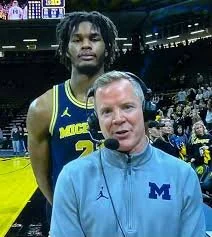
Now, to the important question. What are the "April habits" that you want and need to develop in your organization that will put your organization in the best position to achieve its most ambitious goals?
Resources referenced throughout this article
https://www.nytimes.com/athletic/7177801/2026/04/07/dusty-may-michigan-national-championship-career/